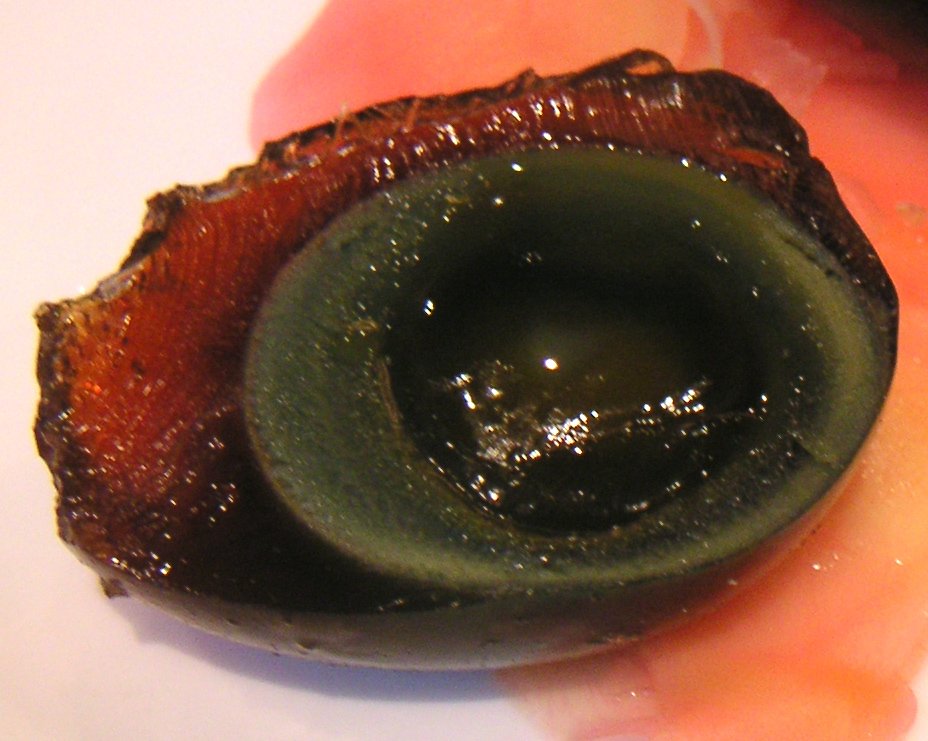
A century egg is a duck, chicken or quail egg preserved for several weeks in a mixture of clay, ash, salt and lime, which turns the white dark and jelly-like and the yolk creamy and green-grey. Despite the name, it is not literally a hundred years old. The process usually takes a few weeks to a couple of months.
The colour change is genuine chemistry, not decay. The alkaline curing mixture raises the pH of the egg to around 9 to 12, which breaks down proteins into smaller, flavourful compounds and releases hydrogen sulfide and ammonia, the two compounds behind the yolk’s green-grey colour and distinctive smell. A faster modern method exists too: eggs are soaked in a salt, calcium hydroxide and sodium carbonate solution for about 10 days, then aged for a few more weeks, rather than cured in clay for months the traditional way. A century egg is roughly 13% protein, similar to a regular hard-boiled egg, so the main change is flavour and texture rather than nutrition.
Where to buy century eggs in the UK
Century eggs are a specialist item, so you will usually need a Chinese grocer or an online order rather than a mainstream supermarket.
Which aisle are century eggs in?
Mainstream UK supermarkets rarely stock century eggs, so they are not found in a standard aisle. Chinese and East Asian grocers keep them refrigerated or with other preserved eggs.
Asian supermarkets
A Chinese grocer is by far the most reliable source, usually selling them individually so you can buy just what you need.
Buying it online
Online is a practical option if you do not have a Chinese grocer nearby, since they keep well and post safely.
Individually wrapped vs multipacks
Century eggs are sometimes sold individually wrapped in their preservation coating, useful if you only want to try one or two, while multipacks work out cheaper if you already know you enjoy them and want to keep some on hand.
What are century eggs?
How to use it
- Sliced into wedges as a cold starter with pickled ginger and soy sauce.
- Stirred into congee for a classic century egg and pork congee.
- Paired with silken tofu as a simple cold dish.
How to prepare a century egg
Peel away the clay or ash coating and shell under running water, then rinse the egg itself, since the coating can be gritty. Cut into wedges with a thin, wet knife or a length of thread, similar to slicing a soft cheese, since the yolk in particular can stick to a dry blade.
Buying and storing century eggs
Unpeeled century eggs, still in their coating, keep for weeks at room temperature in a cool spot, similar to how they are traditionally stored before eating. Once peeled, treat them like a regular cooked egg and refrigerate, using within a couple of days, since the distinctive jelly-like white can dry out if left uncovered.
Is there really an unusual smell?
A faint sulphurous note is normal and expected, similar to a strong hard-boiled egg, and is not a sign of spoilage. It is much milder than the appearance and reputation suggest, and softens further once paired with the acidity of pickled ginger or a splash of soy sauce and vinegar, which is why it is traditionally served with both.
How to store century eggs
Unopened, keep at room temperature as sold. Once shelled, use within a day or two and keep refrigerated.
Frequently asked questions
Is century egg safe to eat?
Yes, it is a traditional preservation method using alkaline ingredients, not literal decay.
What does it taste like?
Savoury and slightly sulphurous, with a creamy yolk. Milder than the appearance suggests.
How long do century eggs keep unopened?
Several weeks to a few months at room temperature, depending on the preservation method, check the packaging for guidance.