Some links on this page are affiliate links. If you buy through them we may earn a small commission, at no extra cost to you.
A wok is one of the cheapest pans you will ever buy and one of the few that gets better with use. The expensive ones are usually worse.
Which wok should you buy?
Buy a flat bottomed carbon steel wok around 30 to 32 cm across, between 1.5 and 2 mm thick, with a long riveted handle. Carbon steel is light, cheap and becomes naturally non stick once seasoned. Skip aluminium, skip anything with a heavy coating, and skip round bottoms unless you cook on gas with a wok ring.
Carbon steel, cast iron, non stick or stainless?
| Carbon steel | Cast iron | Non stick | Stainless | |
|---|---|---|---|---|
| Weight | Light, easy to toss | Heavy | Light | Medium |
| Takes high heat | Yes | Yes | No, the coating degrades | Yes |
| Needs seasoning | Yes | Yes | No | No |
| Food sticks | No, once seasoned | No, once seasoned | No, until the coating wears | Yes |
| Lifespan | Decades | Decades | A few years | Decades |
Carbon steel wins for almost everyone. Non stick is the easier start but a wok is meant to run hot, and high heat is exactly what wears a coating out.
Flat base or round base?
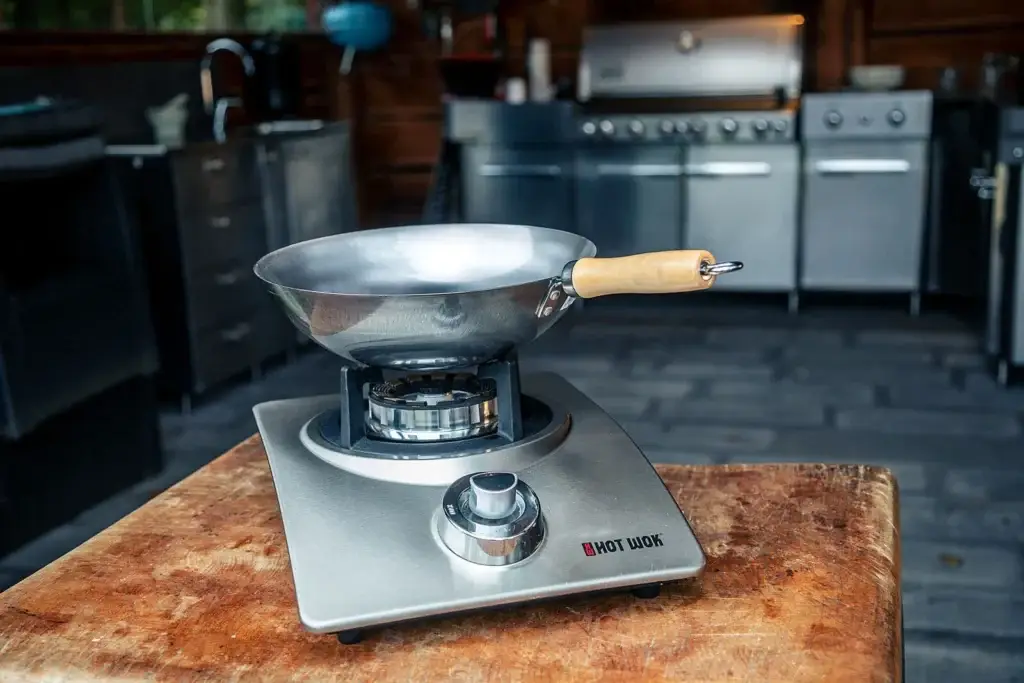
Flat, for a British kitchen. Round bottomed woks are built for restaurant gas burners that surround the pan with flame, and they will not sit properly on an electric or induction hob. A wok ring holds a round pan steady over a gas ring but does nothing on any other hob type.
On induction the base has to be flat and magnetic, and at least 12 cm across, or the hob may not detect the pan.
What size to get
- 28 cm. One to two portions. Fits a small hob and a small cupboard.
- 30 to 32 cm. Three to four portions. The right answer for most households.
- 36 cm. Four to six portions, but check it fits your hob and your sink.
Bigger is not better. A wok wider than the heat source only cooks in the middle, and the sides stay cold.
Thickness and handles
Look for 1.5 to 2 mm carbon steel. Thinner steel heats fast but warps, and a warped base sits badly on a flat hob. Thicker steel is slow to respond and heavy to move.
A long wooden or phenolic handle stays cool and lets you toss the pan. Check it is riveted rather than spot welded, since welds are what fail first. A small helper handle opposite makes lifting a full wok much easier.
Seasoning and care
A new carbon steel wok arrives with a factory coating that has to be scrubbed off before you season it. After that, the black patina builds with use and does the job a non stick coating does, without wearing out.
- Wash with hot water and a soft brush, not with a scourer.
- Dry it on the hob, not on the draining board. Damp carbon steel rusts overnight.
- Wipe a thin film of oil over the inside while it is still warm.
- Cook fatty things in it early on. Bacon and fried eggs build patina fast.
- Rust is not fatal. Scrub it back and season again.
Frequently asked questions
Is an expensive wok worth it?
Rarely. A plain carbon steel wok costing very little outperforms most expensive coated pans, because the material and the base shape are what matter. Spend the difference on a decent burner or a wider hob ring instead.
Can you use a wok on an electric hob?
Yes, with a flat base. Electric and ceramic hobs heat only where the pan touches, so preheat for longer than you would on gas and cook in smaller batches to keep the temperature up.
Do you need to season a non stick wok?
No. Seasoning is for bare carbon steel and cast iron. A non stick wok is ready to use, but it will not take the fierce heat a stir fry wants, and the coating will not last.
What size wok is best for a family?
30 to 32 cm covers three to four portions comfortably. Go to 36 cm only if you regularly cook for five or more and your hob is wide enough to heat the base properly.
Where to buy
Options on Amazon UK that match what is described above. These are affiliate links, so we may earn a small commission if you buy through them. Stock and prices change, so check the listing before ordering.
- Ken Hom Carbon Steel Non-Stick Wok 28cm. A sensible size for two to three portions, with a flat base for a domestic hob.
- Ken Hom Excellence 36cm carbon steel wok. 1.8 mm carbon steel, natural patina rather than a coating. For four to six portions.
- More carbon steel woks. Skip the aluminium and thin non stick pans. They warp and never season.